

After a family member (the “Decedent,” for brevity) passes away, one of the common questions among the surviving family members is how to deal with the properties that the Decedent left behind. There may be real and personal properties registered under the name of the Decedent. Money deposited in the bank, stock certificates, club shares,…
One of the innovations introduced by Republic Act No. 11232, otherwise known as the “Revised Corporation Code of the Philippines” (RCC) is the One Person Corporation (OPC). OPCs offer many advantages for small and medium enterprises (SMEs) in terms of limitations on liability and taxation benefits, among others. The benefit of limiting the business owner’s…
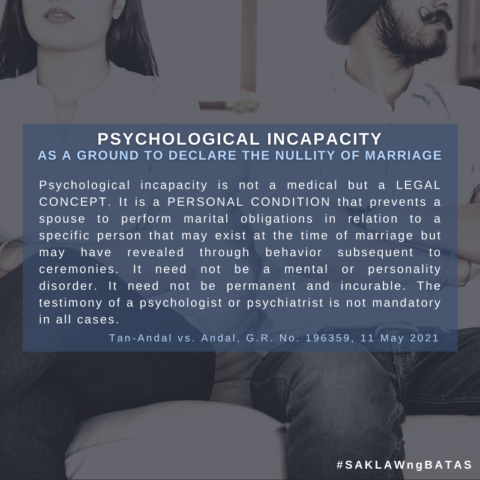
In the case of Tan-Andal vs. Andal, G.R. No. 196359, 11 May 2021, the Supreme Court (SC) En Banc modified the interpretation of the requirements of psychological incapacity as a ground for the declaration of nullity of marriage. According to the SC, psychological incapacity is not a medical but a legal concept. It is a…
Legal preparedness during ‘business unusual’ As published in the Inquirer on May 13, 2020 By Patricia B. Miranda and Salma F. Angkaya-Kuhutan The COVID-19 crisis is teaching us very hard lessons about what happens when we fail to collectively anticipate and plan for this type of worst-case scenario. Aside from our health care system, the building…
Reduction of Corporate Income Taxes Republic Act No. 11534, otherwise known as the “Corporate Recovery and Tax Incentives for Enterprises” (CREATE) Act is the second package of the Comprehensive Tax Reform Program that reduces corporate Income tax rates. The CREATE Act also provides other tax relief measures that will help businesses, particularly those organized as…